|
Who are We?
We have travelled backwards in time on this subject by discussing clans first and then the Vikings, so now we must go back one more step to the beginning of the “Ice ages”. Thousands of years ago, the land we call Scotland was covered in ice and was uninhabited. The ice advanced southwards during each ice age and retreated northwards during the intervening interglacials. People from the south moved up to the edge of the ice as it retreated, and moved back to the south whenever it advanced.
When the “Ice age” finally settled down (about 8000 BC) and the land became habitable, on a more permanent basis, the roving people from the south, and water-borne humans from the east, stayed in the area and started to farm and crop the land. They were a hardy race, and there were several groups of them. You might be tempted to call them Clans, but they were in fact more like a race of people.
The most commonly known of them were the Picts. This is not to say that the Picts were the first settlers in this area. The various groups, who had the ability to withstand the cold conditions, were separated by natural barriers, such as lochs and mountains.
Let me digress for a moment. If you have read Jean Auel’s book, The Clan of the Cave Bear, from her Earth’s Children series, then you will understand a lot better what the conditions were like, and what the people that lived in these areas had to endure. Although this book was about people living on the northern shores of the Black Sea, and who later in the series travelled through Europe to southern France, it describes conditions very similar to those occurring in Scotland at the time we are talking about. (If you have not read the books in this series, they are well worth obtaining and reading. Details of the series are given below). Let me also point out that the people who moved up from the south were not the English, as we know them today.
Different races were moving around the world, and were forced to move on when the food in the area had been used up. They were not farmers, as we know them, but “Hunter Gatherers”. Once the berries on the trees and the easily caught animals had been exhausted, they were forced to move on to the next area. This system meant that some tribes simply moved in a line, while others moved in circles.
In Scotland the earliest signs of occupation are at the farm of Morton, on the Firth of Tay. Traces of occupation by man have been found in this area, dating back to 6000 BC.
In the very early days of the hunter gatherers in Scotland, there were only a very few in the area and they were nomadic. Some middens have shown that they came and went, and then later came back to the same area, because it was good hunting, or the bushes and trees had plenty of berries. Once the area was cleaned out of food, then the group moved on to the next “known area”. This movement of camps must have been a difficult time, as the whole group had to remove and pack hides that were used to cover their tents, plus the poles had to be pulled up and bundled for transport. It was better to take your best poles, as cutting new ones from the trees was a slow and arduous task with a stone axe. For a difficult journey, they would only take whatever was absolutely necessary, and replenish when they arrived at the new campsite. There have been sites found in Scotland, where post holes have been found, that were dug hundreds of years ago. Just for a moment imagine turning up with a post hole digger and a chainsaw? You would have been made a chief straight away.
This equipment had to be mostly carried on the backs of the people. Due to this, older people were often left, along with the young females, who had become pregnant, if the travelling was going to be difficult or dangerous. They would catch up with the main group, when the weather improved, or when the main group returned.
Sometimes the two groups never reunited and a sub group was formed. From this you can see the early formation of clans, and their associated groups.
We have dealt with the Viking invasion and the effect of the Roman push up from the south, in previous articles. It now leaves only the comparatively modern times of the last few hundred years.
The earlier small groups amalgamated into larger groups, and other groups looked to stronger groups to protect them. This all happened in their specific areas. There were times when several groups joined together to do battle with the common foe.
After the population built up in each area, groups called clans were formed. As these people were all related, they assumed the same name. Surnames, as we know them, were not used in Scotland in the very early days. You became known by your physical size, or hair colouring, or what you did as your contribution to the life of the group.
These names have changed over the years, and some have been changed to the English spelling. Fleschan became Flesher, which is the old word for a Butcher. Fletcher was derived from Flechier, who was an arrow maker. Families were known by the trade or occupation of the father. Christian names only helped to identify which member of the family you were talking about. In New Zealand, it is not uncommon for Maori children to be called one, two or three, referring to the order they were born in. Tahi equals one, Rua equals two and Toru equals three. The Mac, in front of a large number of Scottish names, simply means Son of, which begs the question of how can a girl be called Son of? The answer is, of course, that she can’t. Her designation is Nic, which is an abbreviation of the Gaelic word for a girl (Nighean).
In some small fishing villages one or two names cover the whole group. For instance in Buckie, in the 1940s, there were twenty five men called George Cowie. To sort this lot out, when ordering groceries, the name of the wife of a married man was used. He may go down in the book as George Betty or George Mary. For unmarried men, their nicknames were used. It could be Big Ears George or Squinty George.
Over many years there have been many changes in the language of Scotland and, no doubt, some of the original names have been changed so much, that they have lost all recognition with the original name or pronunciation. Some of the nicknames could possibly have become family names over a long period of time.
Our clan name is one of these. Camadh (the dh is usually silent in gaelic), which means crooked, and Beul means mouth. If you put the two words together you get Camadh Beul, with the meaning of crooked mouth. Over the years this became Campbel and finally Campbell. Somewhere, back in time, someone had a mouth that was crooked, or possibly a mouth that had suffered a sword cut in some battle, and his appearance gave him the nickname from which we draw our name. He may also have had a squint, which drew up one corner of his mouth. This feature is still carried by many of today’s Campbells.
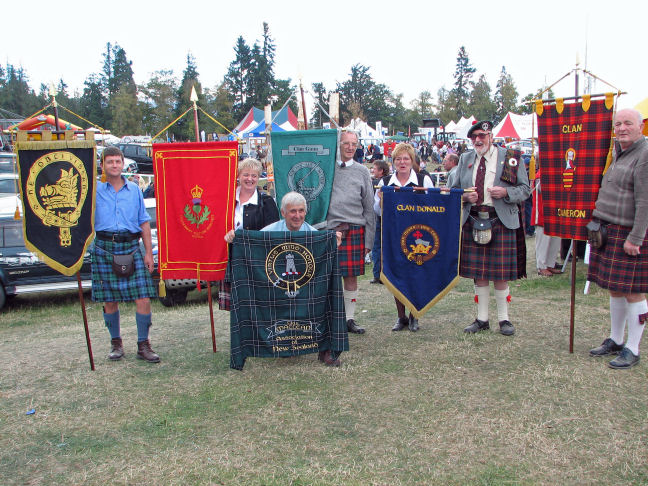
The Camerons have a similar name, as once again the Cam means crooked and Sron is Gaelic for nose. A broken nose in a fight some time back in history? People changed their names, as, and when, it became necessary. This formed different groups, which are now considered by some people to be ancient clans.
Take the name McGregor, for instance. On account of the many lawless deeds justly or unjustly laid to this group, the name Mac Gregor was proscribed, in 1603, by an act of parliament. This meant that it was lawful to kill a MacGregor, as long as you took proof of the deed to the authorities. A head in a bag after a few days could be anybody, so a lot of old scores were settled at this time.
The MacGregors took evasive action, simply changed their name, and became Roys, Gregors, Stewart, Grant, Dougall, and any other convenient name. When the proscription was withdrawn, some MacGregors reverted to their original name, while others retained their new name. It is no wonder that genealogists have that haunted lost look about them.
When people had lived in a large area, controlled by a powerful Clan, such as Campbell, they often assumed the name of that clan as their own. People who moved into an area for work, or for protection, would change their names to the name of the prominent Chief of the area. Others, who moved into the Clan area, retained their name, but became a Sept of the Clan, and served the Clan in times of need. There is a lot more about names and Clan affiliations, but we can look at that later on. Just remember that you may not be who you think you are, but who cares anyway as long as you are happy.
|
| |
The Flag of Scotland
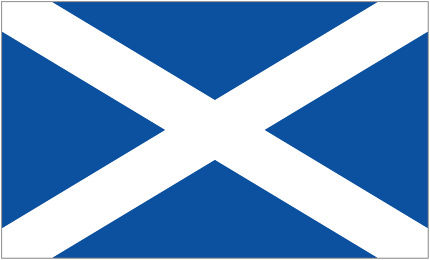
The oldest flag in the British Commonwealth is reputed to be the Saltire Cross of St Andrew. This is the official flag of Scotland. The Saltire Cross is a blue flag with a white diagonal cross on it. According to legends, the diagonal white cross was used, because Saint Andrew refused to be crucified on the same shaped cross as Jesus.
The use of the Saltire Cross, as Scotland’s flag, goes back to about 832AD. If you have been following the history of Scotland, you will realise that Scotland was ruled by several groups, and was not a single country. It was in fact ruled by four different groups, and this is another theory on the use of this flag. It is thought that there was a battle near Athelstaneford, in East Lothian. The battle was fought between Angus MacFergus, King of the Picts of Alba, along with Fochaidh, King of the Scots of Dalriada, who defeated King Athelstan, King of the Angles of Northumbria.
Before the battle King Angus prayed to God, that, in spite of having a smaller army, he would lead his men to victory. On the morning of the battle, the men of Angus’s army saw a formation in the sky, that looked like a white diagonal cross in the blue sky. They took the sign as an omen, and vowed that if they won the battle, then the St Andrew’s cross would become their symbol, and St Andrew would become the patron Saint of Scotland.
The Picts and the Scots won the battle, and from then on the cross of Saint Andrew became the flag of Scotland. The Saltaire Cross can be found in the Union Jack, although the blue is a darker blue. The true blue is the azure blue of the sky, which was observed 1100 years ago. It is not uncommon to see the Saltire Cross flying from buildings, or as window stickers on cars. Nowhere does it fly more proudly than at Athelstaneford, in Scotland, where it is hoisted each day, and is floodlit at night time, to remind us of King Angus, his dream, and his victory, all those centuries ago.
|
| |
The Royal Flag of Scotland
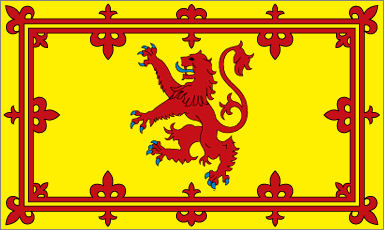
There is of course another flag of Scotland, which is often seen as bumper stickers, or at football matches rather than flying as an actual flag. This flag is yellow, with a lion rampant, in red, in the centre. Rampant simply means rearing up on its hind legs. This flag is known as the Royal Flag of Scotland, or the Scottish Royal Standard.
It goes back to the time of William 1st. The story goes that William was gifted two lions by a knight returning from the crusades. William liked the roaring beasts so much, that he had one depicted, standing upright, claws racking, on his armorial bearings. Every King and Queen of Scotland has used it since.
In the 1100s, heraldic symbols became very popular throughout Europe. They were used as a means of recognition and of power. In the, so called, “good old days”, the noblemen did not actually get involved in the actual dirty work of battle. They sat on their horses, in some prominent position, and watched proceedings. Should the battle not go as planned, they had time to slip away to fight another day.
With the furious hand to hand battles of those days, it was possible to find yourself a bit disoriented and fighting in the wrong direction. To prevent this the nobility wore a mantle over their armour with “their” emblem on it. In addition, they had a flag, with the same emblem on it, flying from the same position. As a foot soldier you simply had to keep your eye on the Chief’s position, so that you knew what direction you were supposed to be hacking with your sword.
Note :- Even today this tactic is practiced. In a rugby match they take the players off at half time, get them all together and tell them that they are all playing in the opposite direction when they go back on the field. This is particularly hard for the forwards to understand.
The Royal Standard was first used by William’s son, Alexander II, who used it on his great seal. In the reign of Alexander III, the standard developed its now familiar frame, known technically as a double tressure flory and counter flory.
Robert the Bruce was handed the Royal Standard in 1306, and it has since been immortalised as being associated with the Lion Rampant. Bruce’s son, David, added the sword to the Royal Standard, the sceptre was introduced in 1542 and the standing lion adorned all the privy seals of the kings until 1603.
In the past, the flag was the flag of Scotland’s monarch. Only he or she was allowed to use it, and it was hoisted only when the King or Queen was there in person. However, as time went by, it was used less and less, until the19th century, when the flag was revived as the “Scotch Standard” that anyone could use.
Today, the flag is almost as widely used as the saltire, and some people even think it is the flag of Scotland, and not that of Scotland’s monarchs. King George V signed a Royal Warrant in 1934, allowing the use of the Rampant Lion flag as "a mark of loyalty", because of the forthcoming Jubilee celebrations. The Lord Lyon officially now takes the view that this permission "related to decorative ebullition", that is, it is permissible to wave the flag at football matches. It is however not allowable to fly the flag without permission, on a flag pole, or from a building. The Lord Lyon once threatened the town councillors of Cumbernauld, with an Act passed in 1679, which prescribed the death penalty for misuse of the royal arms.
|